

The Complete Beginner's Guide to Indoor Saffron Farming (2026)
- Jun 8
- 4 min read
How India Can Transform the World's Most Expensive Spice Through Technology
Written for Precite.ai In Association with Dosajh Industries Led by Archit Dosajh
Introduction
Imagine paying ₹500 for just one gram of spice.
That spice is saffron—often called Red Gold and recognized as the world's most expensive spice.
But why is saffron so valuable? Why does one kilogram sell for ₹5 lakh to ₹10 lakh? And how is indoor saffron farming creating a massive opportunity for entrepreneurs, agritech startups, and farmers across India?
This complete guide explains everything you need to know about saffron farming, from the history of the crop to modern AI-powered indoor cultivation systems.

What is Saffron?
Saffron comes from the flower Crocus sativus.
Inside every flower are three delicate red threads called stigmas. These stigmas are harvested, dried, and sold as saffron spice.
The rest of the flower has no commercial value.
A Simple Way to Understand It
Think of a saffron flower as a jewelry box.
The purple petals are the packaging.
The three red stigmas inside are the diamonds.
Those three threads are what the entire industry revolves around.
Why Is Saffron So Expensive?
The answer is simple:
Extreme labor requirements.
The Mathematics Behind 1 Kilogram of Saffron
Metric | Value |
Stigmas per flower | 3 |
Flowers required | ~150,000 |
Stigmas harvested | ~450,000 |
Harvest method | 100% hand-picked |
Labor required | 400+ hours |
Bloom period | 24–48 hours |
Weight lost during drying | ~80% |
Every flower must be harvested by hand.
Each stigma must be separated manually.
Miss the bloom window and the flower becomes unusable.
This is why premium Kashmiri Mongra saffron can command prices between ₹5 lakh and ₹10 lakh per kilogram.
The History of Saffron Farming
Saffron has been cultivated for thousands of years.
Timeline
50,000 years ago – Saffron pigments appear in cave art.
3,500 years ago – Cultivated across ancient Persia.
3,000 years ago – Depicted in Minoan frescoes.
Around 1,000 years ago – Introduced to Kashmir.
700 AD – Spread to Spain.
Today – Used in food, medicine, cosmetics, Ayurveda, and nutraceuticals.
Saffron has survived empires, wars, and economic revolutions—yet its cultivation methods remained largely unchanged.
Until now.
Traditional Saffron Farming Explained
Major Saffron-Producing Regions
Iran
Produces approximately 90% of the world's saffron.
Kashmir, India
Produces some of the world's highest-quality saffron, especially Pampore saffron.
Afghanistan
Fastest-growing saffron-producing nation.
Spain
Major saffron processor and exporter.
Greece and Morocco
Known for premium PDO-certified saffron.
The Traditional Saffron Growing Cycle
June to August
Corms remain dormant underground.
September
Flower buds begin forming.
October to November
Flowers bloom and harvesting begins.
November to April
Leaves grow and daughter corms develop.
May
Plants become dormant and the cycle resets.
The key challenge?
Farmers get only one harvest opportunity each year.
Why Traditional Saffron Farming Is Struggling
The saffron industry faces major structural challenges.
1. Climate Change
Temperature fluctuations directly affect flowering.
2. Water Stress
Erratic rainfall impacts corm development.
3. Soil Fatigue
Fields lose productivity after several years.
4. Labor Dependency
Saffron remains one of the most labor-intensive crops.
5. Adulteration
A large portion of saffron sold in markets is mixed or fake.
6. Production Decline
Kashmir's saffron output has fallen dramatically over the past decade.
The Indoor Saffron Farming Revolution
Indoor saffron farming solves many of the challenges faced by traditional cultivation.
Instead of relying on nature, growers create ideal growing conditions inside climate-controlled chambers.
Components of an Indoor Saffron Farm
Multi-layer vertical racks
LED lighting systems
Humidity control units
Air circulation systems
CO₂ management
AI-powered climate automation
Real-time monitoring sensors
In simple terms:
The farm becomes a software-controlled environment.

How Vertical Saffron Farming Works
Traditional farms use one growing layer spread across acres.
Vertical farms stack multiple growing layers inside a room.
Comparison
Traditional Farming | Vertical Farming |
Requires large land area | Uses compact indoor space |
One growing layer | Multiple stacked layers |
Weather dependent | Climate controlled |
Seasonal income | Multiple annual harvests |
A small indoor room can generate significantly higher productivity per square foot than traditional fields.
The Four Critical Factors in Indoor Saffron Farming
Successful indoor saffron cultivation depends on controlling four environmental variables.
Temperature
The most important factor.
Small fluctuations can significantly impact flowering.
Humidity
Improper humidity leads to corm rot and disease.
Light
Controls flower formation and quality.
CO₂ and Airflow
Essential for healthy growth and optimal stigma development.
Maintaining these parameters consistently is the secret to successful indoor cultivation.
Indoor vs Traditional Saffron Farming
Factor | Traditional Farming | Indoor Farming |
Harvests per year | 1 | 2–4 |
Weather dependency | High | None |
Water consumption | High | Up to 90% lower |
Soil diseases | Common | Minimal |
Yield consistency | Variable | Predictable |
Location restrictions | Limited | Anywhere |
The Future of Saffron Farming
Several trends are reshaping the industry.
AI-Powered Climate Control
Automation systems continuously optimize growing conditions.
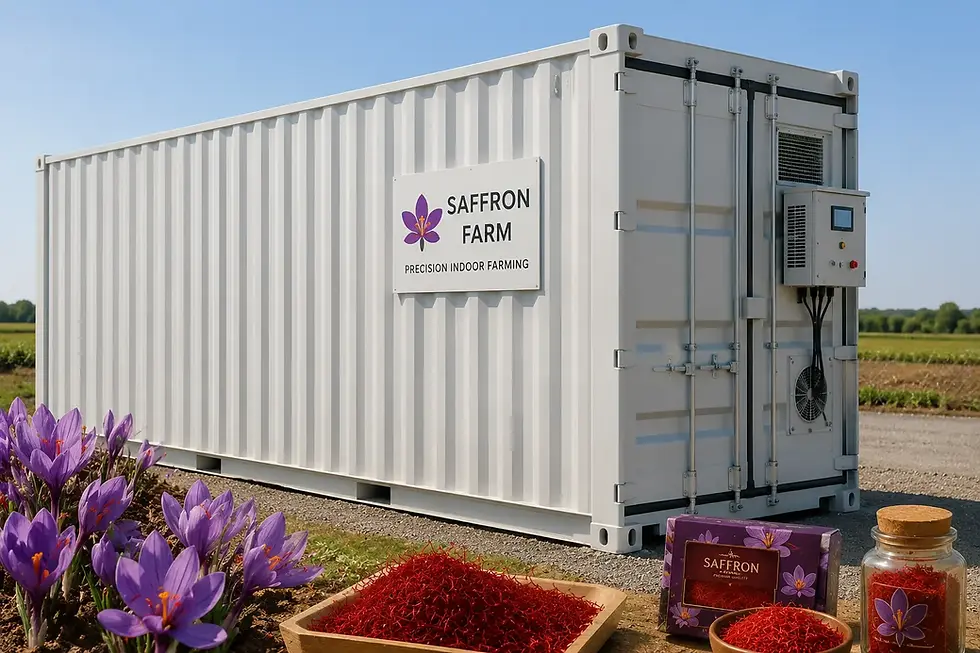
Plug-and-Play Saffron Chambers
Pre-engineered units reduce setup complexity.
Urban Agriculture
Commercial saffron farms are moving into cities.
Expanding Industrial Demand
Demand is increasing from:
Pharmaceuticals
Nutraceuticals
Cosmetics
Premium Food Brands
Ayurveda
The Global Saffron Market Opportunity
Market Size
Metric | Value |
2025 Market Size | USD 1.2–1.5 Billion |
2031 Projection | USD 2–2.6 Billion |
CAGR | 6–8% |
The industry is growing steadily while supply remains constrained.
India's Massive Saffron Opportunity
India consumes significantly more saffron than it produces.
Estimated Annual Figures
Metric | Volume |
Demand | ~100 tonnes |
Domestic Production | 6–20 tonnes |
Import Gap | ~80 tonnes |
This import dependency creates a major opportunity for indoor saffron farming entrepreneurs.
Every kilogram produced domestically reduces imports.
How Precite.ai is Transforming Indoor Saffron Farming
Many indoor saffron projects fail because generic climate-control systems are not designed specifically for saffron cultivation.
Precite.ai focuses on:
Precision Climate Control
Maintaining ideal environmental conditions throughout the growth cycle.
AI-Based Optimization
Systems learn from operational data and improve performance over time.
Full Automation
Unified control of cooling, heating, lighting, humidity, airflow, and monitoring.
Remote Monitoring
Real-time chamber management through mobile and desktop dashboards.
Post-Harvest Cold Storage
Protecting crocin, safranal, and picrocrocin content after harvesting.
The goal is simple:
Transform saffron cultivation from a seasonal agricultural activity into a predictable, technology-driven industry.
Frequently Asked Questions (FAQs)
Is indoor saffron farming profitable?
Indoor saffron farming can be profitable when proper climate control, corm quality, and operational management are maintained.
How many harvests can indoor saffron farms achieve?
Typically 2–4 harvests per year, depending on the cultivation system.
Can saffron be grown outside Kashmir?
Yes. Indoor climate-controlled chambers can recreate ideal saffron-growing conditions anywhere in India.
How much space is required?
Commercial setups can begin from as little as 100 square feet.
Why is AI important in saffron farming?
AI helps maintain precise environmental conditions and reduces human error.



Comments