

Indoor Saffron Farming Setup Cost: A Complete Breakdown for 2026
- May 22
- 11 min read
Updated: 4 days ago
Saffron — the world's most expensive spice — is now being grown indoors. And the first question every serious grower asks is the right one: what does it actually cost?
The promise of indoor saffron farming is real. Year-round harvests, premium prices, zero dependency on Kashmir's climate or Iran's supply chain. But so is the risk of going in underprepared. Setup costs are significant, equipment choices matter enormously, and inflated income claims online can lead new growers straight to a loss.
This guide cuts through the noise. It breaks down every major cost category — initial setup, corms, equipment, operations, and realistic returns — so you can build your indoor saffron farm on solid numbers, not wishful thinking.
Table of Contents

Why Indoor Saffron Farming Is Gaining Momentum
Saffron (Crocus sativus) has been grown for centuries in the cool, dry highlands of Kashmir, Iran, and Spain. Those regions still dominate global supply — but the market is outgrowing what traditional farming can reliably deliver.
The global saffron market was valued at $629.76 million in 2024 and is projected to reach $941.23 million by 2030, growing at a CAGR of nearly 7%. Climate change, inconsistent yields, and supply chain volatility are making buyers — from food brands to pharmaceutical companies — actively seek stable, high-quality sources. That gap is exactly what indoor farming fills.
The core advantages of growing saffron indoors:
Up to 2 harvests per year, versus the single annual harvest of traditional outdoor farming
300%+ higher yield per square foot compared to field cultivation
Complete weather independence — drought, frost, and flooding have no impact on your crop
Dramatically reduced pest and disease risk, with no soil-borne pathogens or rodents
Consistent, premium-grade output that commands top market prices year-round
These advantages are real. So are the costs. Understanding both is what separates profitable indoor saffron farmers from those who invest and stall.
Initial Setup Cost: What You'll Spend to Get Started
The most common question from new growers: how much does it cost to set up an indoor saffron farm?
There is no single answer — it depends on your farm size, location, and growing method (hydroponic, aeroponic, or soil-based vertical racks). Here is a practical range by scale:
Farm Scale | Area | Estimated Setup Cost (India) | Estimated Setup Cost (US/Global) |
Hobby / Trial | 100–200 sq. ft. | ₹5–6 lakhs | $10,000–$25,000 |
Small Commercial | 500 sq. ft. | ₹10–15 lakhs | $50,000–$100,000 |
Mid-Scale | 1,000–2,000 sq. ft. | ₹20–35 lakhs | $100,000–$200,000 |
Large Vertical Farm | 5,000+ sq. ft. | ₹1 Cr+ | $200,000–$500,000+ |
A useful real-world benchmark: a 160 sq. ft. aeroponic unit costs approximately ₹8–10 lakhs all-in and can produce around 500-600 grams of saffron annually. That single data point — small room, modest investment, meaningful yield — is why so many first-time growers start here before scaling up.
Price of Saffron Corms (Bulbs)
The saffron corm is the biological engine of your farm — and often the single largest line item in your startup budget. Get this right, and everything else becomes easier. Cut corners here, and no amount of good equipment will save your first harvest.
What corms cost:
In India, high-quality Crocus sativus corms typically cost ₹1500–2500 per kg
In international markets, prices range from $0.50–$1.50 per corm
The recommended planting density is 20–30 corms per square feet — dense enough to maximize yield, spaced enough to prevent disease
For a 500 sq. ft. (≈46 sq. m.) farm, you will need roughly 500–600 kg corms, putting first-batch corm costs between ₹80,000 and ₹1.8 lakhs
At US commercial scale — 100,000 corms per acre at $0.50 each — the biological investment alone reaches $50,000 per acre
One rule that experienced growers repeat constantly: buy only from certified, reputable suppliers. Cheap, low-quality corms are the leading cause of poor yield in first-year indoor saffron operations. The savings on procurement become far more expensive losses at harvest.

Saffron Equipment and Infrastructure Costs
Corms grow in a field. They thrive in a controlled environment. Building that environment is where indoor saffron farming cost gets real — and where the right choices make or break your ROI.
Here is a breakdown of every major equipment category:
1. Vertical Rack Systems
The structural backbone of your indoor farm. Stacked growing racks allow you to multiply your usable area dramatically — fitting far more corms per square meter than any floor-level setup.
Estimated cost: ₹80,000–₹2 lakhs for a 500 sq. ft. setup
2. Saffron LED Grow Lights
Saffron flowering is triggered by specific light spectra — primarily blue and red wavelengths — and by photoperiod cycles that mimic the natural shortening of autumn days. Full-spectrum LED systems with programmable photoperiod controls are the current standard for commercial indoor saffron production.
Estimated cost: ₹1–2.5 lakhs for a 500 sq. ft. setup
3. Saffron Climate Control — Cold Room & Humidity Systems
This is the most critical and most expensive system in an indoor saffron farm. Saffron requires cool temperatures — typically 15–18°C during the growth phase — to flower reliably. In most parts of India, where ambient temperatures run well above that, a dedicated cold room or precision cooling system is non-negotiable.
Getting this wrong is the most common and costly mistake in indoor saffron farming. The cooling system must maintain the right temperature not just on average, but consistently — any significant fluctuation disrupts flowering and kills yield.
Specialized providers like Precite.ai offer AI-powered cold room systems built specifically for saffron cultivation. Their integrated solutions cover refrigeration, ultrasonic humidification, CO₂ management, stage-wise automated climate control, and sensor monitoring — with pan-India installation support and setups starting from ₹5 lakhs. For growers who want a complete, engineered cold room rather than piecing together separate components, this kind of end-to-end system significantly reduces the risk of costly climate failures.
Estimated cost: ₹1.5–3 lakhs for standalone equipment; integrated AI cold room systems vary by room size
4. Saffron Aeroponic Growing Systems
Soilless cultivation eliminates soil-borne disease risk and delivers precise nutrients directly to the root zone. Aeroponic misting systems — where roots are suspended in air and misted with nutrient solution — are particularly well-suited to saffron corms and are increasingly the preferred method for high-yield indoor setups.
Estimated cost: ₹1–2 lakhs
5. Irrigation and Misting Units
Moisture management is a delicate balance in saffron farming. Overwatering causes corm rot — one of the most destructive and preventable problems in indoor operations. Automated misting units with soil moisture sensors keep hydration levels precise without constant manual intervention.
Estimated cost: ₹30,000–₹80,000
6. Sensors and Automation
Temperature, humidity, CO₂, and light sensors connected to automated control systems do two things simultaneously: they reduce the daily labor burden and they catch environmental deviations before they damage crops. In a high-value crop like saffron, automation pays for itself quickly.
Estimated cost: ₹50,000–₹1.5 lakhs
Equipment Cost Summary — 500 sq. ft. Farm
Equipment | Estimated Cost (₹) |
Vertical rack setup | 80,000–2,00,000 |
LED grow lights | 1,00,000–2,50,000 |
Climate control systems | 1,50,000–3,00,000 |
Hydroponic / aeroponic system | 1,00,000–2,00,000 |
Irrigation & misting units | 30,000–80,000 |
Automation & sensors | 50,000–1,50,000 |
Total Equipment | ₹5,10,000–₹11,80,000 |
Ongoing Operational Costs
Setup cost is a one-time spend. Operational costs are what determine whether your farm is profitable year after year. Here is what to budget for:
1. Electricity
Climate control dominates the electricity bill. Running a cooling system in a warm climate is expensive — and it runs continuously. A 160 sq. ft. aeroponic unit typically costs around ₹30,000 per year in combined electricity and water expenses. Larger setups scale proportionally, and farms in hot climates pay significantly more than those in naturally cool regions.
2. Corm Management
Saffron corms naturally multiply over a 3–4 year cycle, which progressively reduces your sourcing cost. But a percentage will need replacement each year, and corm health management — proper storage, sorting, and occasionally refrigeration at around 5°C — requires ongoing attention and expense.
3. Post-Harvest Processing
How saffron is dried directly determines its market grade — and its price. Improperly dried threads lose their crocin, picrocrocin, and safranal content, dropping from Grade 1 to a far less valuable grade. Investing in a temperature- and humidity-controlled drying setup is not optional for growers targeting premium markets.
4. Maintenance and Consumables
Nutrient solutions for hydroponic systems, replacement LED modules, equipment servicing, CO₂ canisters, and packaging materials are recurring costs that add up across a full year of operations.
Estimated annual operational cost for a 500 sq. ft. indoor saffron farm: ₹80,000–100,000 lakhs
Indoor vs. Outdoor Saffron Farming: A Cost Comparison
Factor | Outdoor Traditional | Indoor Vertical / Hydroponic |
Setup cost (1 acre equivalent) | $25,000–$75,000 | $100,000–$200,000+ |
Harvests per year | 1 | 2–4 |
Yield consistency | Weather-dependent | Highly consistent |
Pest and disease risk | High | Very low |
Location requirement | Specific cool-dry climate only | Grow anywhere |
Labor during harvest | High, highly seasonal | Manageable, still manual |
Water usage | High | 60%+ lower with automated sensors |
The higher upfront investment of indoor farming is offset over time by multiple annual harvests, dramatically higher yield consistency, and the freedom to operate from any location — including urban and peri-urban settings where logistics and market access are strong.
How Much Can You Earn From Indoor Saffron Farming? Revenue Potential
The revenue side of indoor saffron farming is where the numbers become genuinely compelling — and where it is equally important to stay grounded.
What the market pays:
Premium-quality saffron in India sells for ₹4–8 lakhs per kg, with top-certified product reaching ₹7–8 lakhs per kg
In global markets, prices range from $5,000–$15,000 per kg depending on quality grade, origin certification, and sales channel
A 160 sq. ft. aeroponic unit can yield approximately 800 grams of saffron per year, generating ₹6–8 lakhs in annual revenue
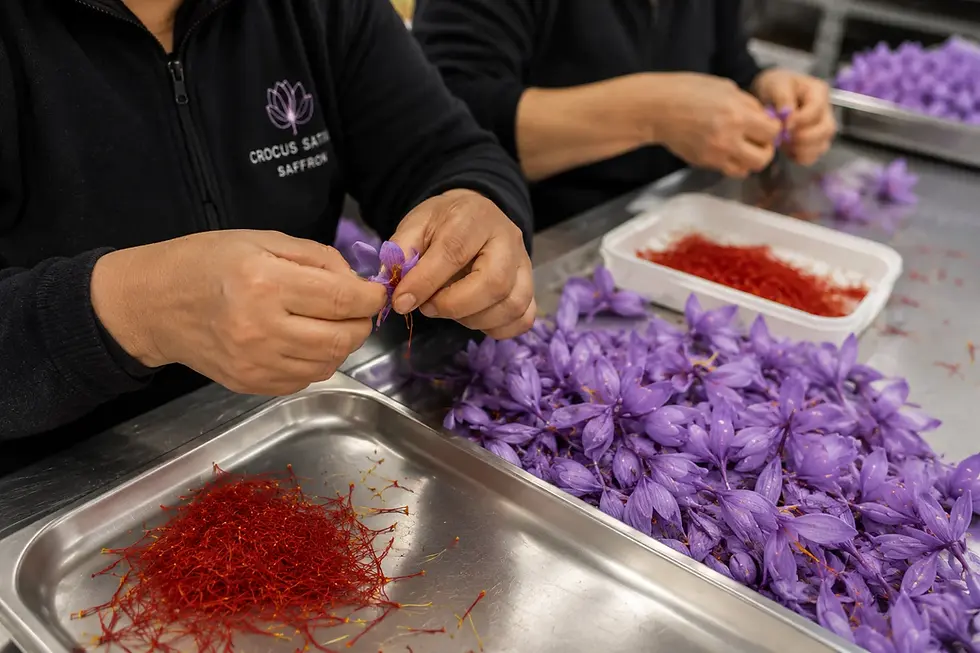
Indian entrepreneurs operating a 225 sq. ft. aeroponic room have reported harvesting 2 kg of saffron in a single season — worth approximately ₹10 lakhs
Revenue projection — 500 sq. ft. indoor farm:
Metric | Estimate |
Annual saffron yield | 2–4 kg |
Market price per kg (India) | ₹4–8 lakhs |
Annual gross revenue | ₹8–32 lakhs |
Annual operational cost | ₹3–6 lakhs |
Estimated annual net profit | ₹5–26 lakhs |
The wide range in that profit figure reflects real variables: quality grade achieved, whether you sell wholesale or direct-to-consumer, and how efficiently your operation runs. A grower selling Grade 1 saffron direct to health brands earns far more per kilogram than one selling bulk to a middleman.
When Will You Break Even?
For a well-managed indoor saffron farm, the break-even point typically falls between 2 and 4 years from the initial investment. In agricultural terms, that is a fast return — a direct consequence of saffron's exceptional market value relative to the farm's footprint.
The factors that move the ROI timeline forward:
Selling directly to end consumers or niche B2B buyers rather than through wholesale
Targeting premium segments — health supplements, luxury food, cosmetics, Ayurvedic brands
Diversifying revenue through value-added products: saffron-infused teas, extracts, skincare oils, or supplements
Consistently achieving Grade 1 certification, which commands a 50–100% price premium over lower grades
Reinvesting Year 1 corm multiplication to expand the farm without additional sourcing cost
Tips to Reduce Indoor Saffron Farming Costs
1. Choose a naturally cool location. Cooling cost is the dominant recurring expense in most indoor saffron farms. If your facility is in a region where temperatures stay below 20°C for extended periods — hilly terrain, higher altitudes, or naturally cold climates — your energy bill drops significantly. Location scouting is worth serious attention before you commit to a lease.
2. Start small, then scale with your own corms. A 160–200 sq. ft. pilot unit is enough to learn the system, identify operational gaps, and generate your first yield. Crucially, saffron corms multiply naturally every year — so your Year 1 stock becomes the seed for a much larger Year 3 farm, without the corm procurement cost of starting fresh.
3. Automate moisture management from Day 1. Overwatering causes corm rot, and corm rot is one of the fastest ways to destroy a year's investment. Automated drip irrigation with soil moisture sensors eliminates the guesswork, reduces water consumption by up to 60%, and pays for itself in corm survival rates alone.
4. Invest in the right climate control system upfront. Underspeccing your cooling and humidity system to save money in setup is a false economy. A system that fails to hold the right temperature range during the critical flowering phase costs far more in lost yield than the equipment savings. Get an engineered solution sized to your specific room and climate conditions.
5. Sell direct-to-consumer wherever possible. Wholesale pricing for saffron is a fraction of what direct buyers pay. An e-commerce presence, direct relationships with restaurants, Ayurvedic brands, or specialty food retailers, and export channels all significantly improve margin on the same kilogram of product.
6. Explore government subsidies. In India, the National Horticulture Board (NHB) and several state agriculture departments offer financial support for spice cultivation projects. Schemes under the National Mission for Sustainable Agriculture (NMSA) may also apply. Checking eligibility before committing capital can meaningfully offset your setup cost.
7. Get a proper equipment quote before finalizing your budget. Equipment costs vary considerably by room size, specification, and supplier. Working with specialized providers like Precite.ai — who offer free custom quotes sized to your exact room dimensions and operational goals — helps you avoid both overspending on oversized systems and under-investing in undersized ones. Their engineering team covers everything from cold rooms to grow lights to sensors, with pan-India installation support.
Is Indoor Saffron Farming Worth the Investment?
Yes — with the right expectations and a disciplined plan.
Indoor saffron farming is not a passive income shortcut. The claims circulating online about earning lakhs per month from a small room without much effort are exaggerated. What is true is that saffron's market value is exceptional, demand is growing, and indoor farming's controlled-environment advantages are real and compounding.
The honest picture:
Year 1 will likely be your most expensive and least profitable, as infrastructure gets established and corms settle into their new environment
Year 2 and 3 are where yields improve, corm stock multiplies, and operational efficiency compounds
By Year 3–4, a well-run farm has typically recovered its setup cost and is generating consistent net profit
The infrastructure cost amortizes across multiple harvests, improving economics year on year
The one data point worth holding onto: saffron generates 8–10 times more revenue per unit area than typical leafy greens in controlled-environment farms. That ratio is why this crop justifies the capital-intensive setup that would be uneconomical for almost any other indoor crop.
Plan carefully. Source quality corms. Get your climate control right. And target the right markets from the beginning.
Frequently Asked Questions
How much does it cost to start indoor saffron farming in India? For a small commercial setup of around 500 sq. ft., plan for an initial investment of ₹10–15 lakhs. A compact 160 sq. ft. aeroponic pilot unit can be started for ₹8–10 lakhs all-in.
What is the minimum room size for indoor saffron farming? You can start with as little as 100 sq. ft. (10×10 ft.) for a trial or hobby unit. For commercial viability, most growers recommend a minimum of 200–500 sq. ft. to generate meaningful yield and justify the infrastructure investment.
Is indoor saffron farming profitable? Yes — when managed well. Saffron's premium market price means even modest yields produce significant revenue. Most well-run indoor operations reach profitability within 2–4 years of setup.
What is the best growing method for indoor saffron? Aeroponic and hydroponic systems consistently outperform soil-based methods for yield consistency, water efficiency, and disease control. Vertical aeroponic racks are currently the leading commercial standard for indoor saffron production globally. If you are evaluating complete setup options, Precite.ai's saffron cold room systems combine the growing environment, climate control, and automation into one integrated solution — worth reviewing before finalizing your equipment plan.
How many harvests can you get from indoor saffron per year? With properly managed light cycles and temperature control, indoor aeroponic saffron systems can produce up to 4 harvests per year — compared to the single annual harvest of traditional outdoor cultivation. This multiple-harvest advantage is the core economic driver of indoor farming's ROI.
What is the market price of saffron in 2025–2026? In India, premium-quality saffron trades at ₹4–8 lakhs per kg, with top-grade certified product reaching ₹7–8 lakhs. Internationally, prices range from $5–$15 per gram ($5,000–$15,000 per kg), depending on quality grade, certification, origin, and sales channel.
Final Thoughts
Indoor saffron farming sits at a rare intersection: a genuinely high-value crop, a proven controlled-environment model, and a global market that is growing faster than traditional farming can reliably supply. The costs are significant and the learning curve is real — but for growers who approach it with accurate numbers, quality inputs, and the right infrastructure, the economics are among the strongest in modern agri-entrepreneurship.
Start with solid data. Source quality corms. Invest in climate control you can trust. Sell into premium markets from your first harvest. The red gold of the spice world rewards those who do the groundwork.
Have questions about starting your indoor saffron farm? Drop them in the comments below.




Comments