


How Long Does Saffron Take to Grow? A Complete Timeline
Saffron is often called the world’s most expensive spice, and its price reflects how slow and labour-intensive it is to produce. For investors, agri-entrepreneurs and facility planners evaluating a saffron project, the first practical question is about time: how long does saffron take to grow from planting to a sellable harvest, and what can go wrong along the way?
The short answer is that saffron is not grown from seed, and its timeline depends on corm size, climate and growing method. This guide breaks down each stage of the saffron cultivation timeline, compares outdoor and indoor production, and explains where climate control and automation reduce risk.

How Long Does Saffron Take to Grow? The Short Answer
Saffron takes roughly 6 to 12 weeks from planting a flowering-size corm to the first harvest of stigmas, and about three years to reach a stable, commercially meaningful yield.
First flowers: typically within one season of planting healthy, flowering-size corms.
Harvest window: a short burst of about two to three weeks, during which flowers are picked by hand.
Full corm cycle: about 12 months, from dormancy through flowering, leaf growth and back to dormancy.
Commercial maturity: about three years, as corms multiply and the planting bed or tray system stabilises.
Timelines vary by cultivar, corm quality and climate, so treat these ranges as planning benchmarks and validate them with a local agronomist.
Why Saffron Is Not Grown From Seed
Saffron (Crocus sativus) is a sterile triploid plant. It cannot produce viable seed, so every crop starts from a corm, an underground storage organ similar to a bulb. Corms multiply vegetatively: each mother corm produces daughter corms during the growing season.
This has direct business consequences:
Your starting material is a purchased or self-propagated asset, and its size and health set the ceiling on your first-year yield.
Corms below a minimum size will produce leaves but few or no flowers.
Expansion is slow, because you scale by multiplying corms, not by sowing more seed.
The Saffron Growing Timeline, Stage by Stage
Stage 1: Corm Dormancy and Floral Initiation (Summer)
After the previous season’s leaves die back, corms rest through the warm months. This stage is not idle. Inside the corm, the flower buds are being formed, and the process is sensitive to temperature. Research on saffron physiology generally points to warm storage in the mid-20s °C for floral initiation, followed by cooler conditions to trigger emergence.
In traditional saffron regions such as Kashmir, this happens naturally over the summer. In controlled environments, it is managed deliberately.
Stage 2: Planting and Flower Emergence (Early Autumn)
Corms are planted in late summer to early autumn in outdoor regions. Flower spikes emerge within weeks, once temperatures drop into a cooler range. This is the point at which the timeline becomes visible to a farm owner.
Stage 3: Flowering and Harvest (Autumn, about 2 to 3 weeks)
Saffron flowers bloom for a short period. Each flower lasts only a day or two, and the stigmas must be picked by hand, ideally in the morning before the flower wilts. Each flower yields only three stigmas, and it takes well over a hundred thousand flowers to produce a kilogram of dried saffron. That is why labour planning and picking discipline matter so much.
Post-harvest processing, mainly gentle drying, must follow quickly to protect colour, aroma and flavour compounds such as crocin, picrocrocin and safranal, which determine quality grading.
Stage 4: Leaf Growth and Corm Multiplication (Winter to Spring)
After flowering, the plant grows grass-like leaves that feed the corm. This stage is when daughter corms form and grow. Cutting corners here, through poor light, irrigation or nutrition, reduces next season’s flowering.
Stage 5: Return to Dormancy (Late Spring)
Leaves yellow and die back, and the corms rest again. Growers lift and grade corms, discard diseased ones and replant the best.
Summary Timeline
Stage | Typical Period | Key Variable |
Dormancy and floral initiation | Summer | Warm-storage temperature |
Planting and emergence | Late summer to early autumn | Cooling trigger, corm size |
Flowering and harvest | About 2 to 3 weeks in autumn | Temperature, humidity, labour |
Leaf growth and corm multiplication | Winter to spring | Light, water, nutrition |
Return to dormancy | Late spring | Disease control, grading |
Commercial maturity | About 3 years | Corm multiplication rate |
Outdoor vs Indoor Saffron: How the Timeline Changes
Traditional field cultivation gives you one crop per year, entirely at the mercy of weather. A late warm spell, early frost or heavy rain can shorten or damage the short flowering window.
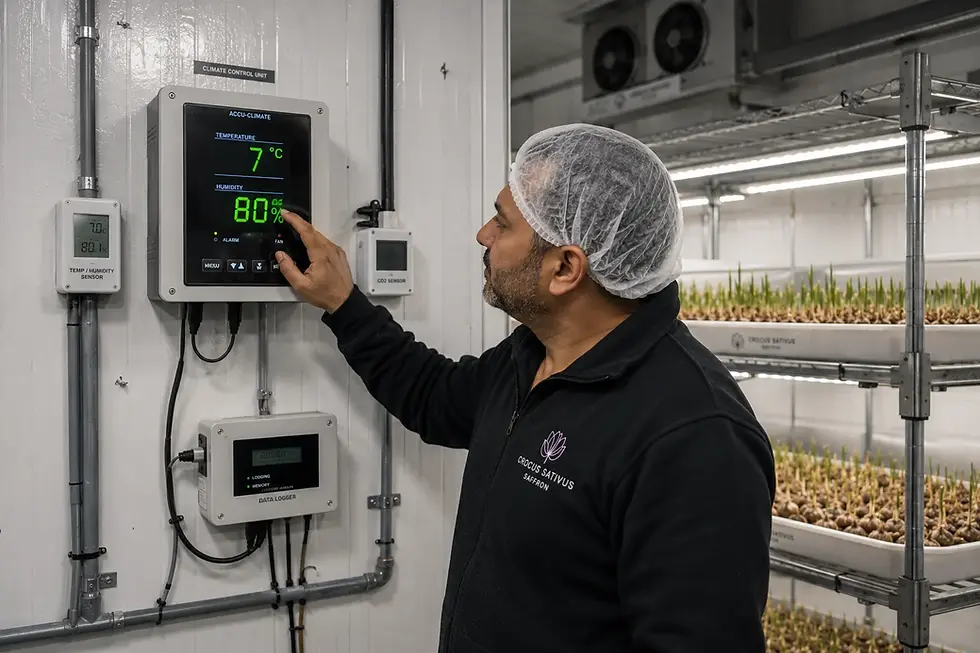
Indoor saffron farming, using climate-controlled rooms with racks, lighting and precise temperature management, changes the economics in three ways:
Predictability: Temperature and humidity are managed through each phase, so flowering can be scheduled rather than left to the season.
Reduced weather risk: Rain, pests and soil-borne disease exposure fall significantly.
Space efficiency: Vertical racking increases output per square metre, although energy cost becomes the main operating variable.
Indoor systems still follow the biological cycle of the corm. Controlled environments do not make saffron “fast”. They make it repeatable. The value lies in protecting a short, high-value harvest window and cutting the variance between batches.
What Controls Saffron Growing Time
Understanding these factors helps you forecast yield and avoid costly delays:
Corm size and quality: Larger, healthy corms flower more reliably. Small corms often skip flowering in their first year.
Temperature profile: Both the warm initiation phase and the cool emergence phase must be hit within narrow ranges.
Humidity and airflow: Excess moisture raises the risk of corm rot and fungal disease, a leading cause of crop loss.
Light: Important during leaf growth, when the corm builds reserves for the next cycle.
Water management: Saffron dislikes waterlogging, and overwatering is a common failure point.
Harvest timing and labour: Missing the morning picking window directly reduces quality and yield.
Real-World Applications Beyond the Farm
Saffron cultivation shares its engineering challenges with other temperature-sensitive industries. The same control logic applies in:
Cold storage and cold rooms: Holding corms or finished saffron at stable temperature and humidity is the same problem as pharmaceutical or food cold-chain storage, where small excursions cause large losses.
HVAC and process cooling: Chiller plants and air handling units serve both indoor farms and manufacturing sites, and unstable setpoints waste energy in both.
Smart manufacturing: Batch-based processes, such as drying and packing, benefit from the same sensor-driven monitoring used on production lines.
For plant managers, a saffron room is a useful example of a high-value, low-tolerance environment, which makes it a good test of any control system.
How Precite.ai Supports Indoor Saffron and Climate-Critical Facilities
Saffron’s value is concentrated in a few weeks of flowering and a precise temperature schedule. Missing either can erase a season’s return. Precite.ai addresses this with AI-driven industrial automation designed for climate-critical environments:
Phase-based climate programming: Setpoints for the initiation, emergence, flowering and growth phases are scheduled and enforced automatically, which reduces manual intervention and operator error.
Chiller and HVAC optimisation: Machine-learning models adjust chiller loading and airflow to hold tight temperature bands while limiting energy use, which is usually the largest recurring cost of indoor farming.
Predictive maintenance: Vibration, current and temperature trends from compressors, fans and pumps are analysed to flag degradation before a failure occurs. A chiller fault during the flowering window is far more costly than the repair itself.
Real-time monitoring and alerts: Temperature, humidity and CO₂ data are tracked continuously, with deviation alerts sent before crop damage occurs.
Data logging for traceability: Environmental records support quality documentation, which matters to buyers who grade saffron by purity and origin.
The ROI case rests on avoided losses, lower energy consumption and less downtime. Actual savings depend on facility size, equipment age, local power tariffs and baseline control quality, so an assessment of your site is the right starting point for any projection.
Frequently Asked Questions
How long does it take saffron to flower after planting?
With healthy, flowering-size corms and the right cooling trigger, flowers typically appear within a few weeks of planting, and the harvest window lasts about two to three weeks.
How many years does it take to grow saffron commercially?
Most growers reach a stable commercial yield in about three years, as corms multiply and the planting area is established.
Can saffron be grown indoors year-round?
Indoor systems can schedule flowering by controlling temperature and light, but saffron still needs a defined dormancy and growth cycle. It yields one flowering cycle per corm per year, not continuous production.
Why is saffron so expensive?
Each flower yields only three stigmas, picking is manual and time-critical, and a very large number of flowers are needed for a small quantity of dried spice.
What is the biggest risk in saffron cultivation?
Temperature mismanagement and excess moisture. Both can cause failed flowering or corm rot, which is why monitoring and automation matter in indoor setups.





Comments