


Saffron Farming Duration: Complete Timeline from Planting to Harvest (2026)
Saffron is often called the world's most expensive spice, but it is also one of the most schedule-sensitive crops, which makes saffron farming duration a critical planning factor. A missed temperature window, a late harvest, or a slow drying step can reduce both yield and quality grade. For investors, agri-entrepreneurs, and facility managers evaluating a saffron project, the first question is always the same: how long does it actually take?
The answer depends on whether you grow outdoors or in a controlled indoor environment. This guide breaks down the saffron growth cycle stage by stage, explains what drives timeline variation, and shows why climate control infrastructure determines how predictable your harvest will be.

How Long Does Saffron Take from Planting to Harvest?
Outdoors, corms planted in late summer typically flower about six to ten weeks later, in autumn. In a controlled indoor room, flowering typically begins roughly four to eight weeks after corms are placed under flowering conditions. A full agricultural cycle, including leaf growth, corm multiplication, and dormancy, spans about 12 months. Corm beds are commonly renewed every three to five years.
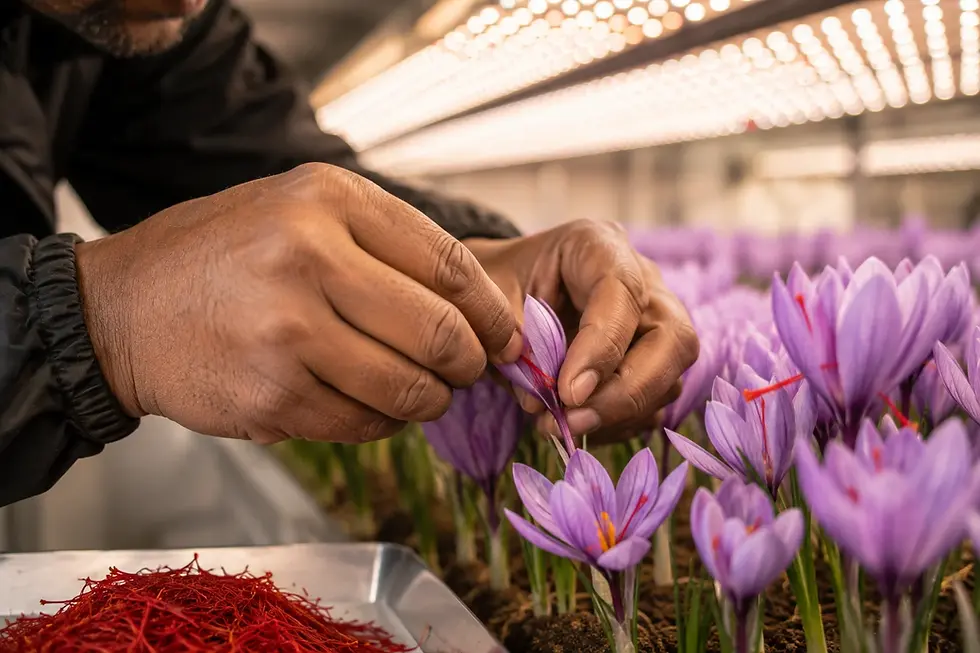
Saffron (Crocus sativus) is a sterile triploid plant, so it is propagated by corms, not seed. Each corm flowers once per cycle, and the harvested product is the three red stigmas inside each flower. Flowers open for roughly a day and must be picked and processed almost immediately.
Understanding the Saffron Growth Cycle
Saffron's rhythm differs from most crops because flowering comes before leaf growth, and the flower is formed inside the corm months earlier.
Dormancy and floral initiation
During summer dormancy, the corm's apical bud develops the flower primordia. Research on saffron physiology links this stage to a sustained warm period, commonly cited around 23 to 27°C. This is the stage most often overlooked by new growers, and it is why corm storage conditions matter as much as field conditions.
Flowering
Once temperatures fall, flowers emerge. The flowering window for a bed usually lasts two to three weeks, with daily picking during peak days.
Vegetative growth and corm multiplication
After flowering, the plant produces narrow grass-like leaves through winter and spring. These leaves photosynthesize and feed the mother corm and its daughter corms. Skipping or damaging this phase weakens next season's flowering.
Outdoor Saffron Farming Timeline
The table below reflects the general pattern in traditional saffron regions such as Kashmir, Iran, and Spain. Exact dates shift with altitude, latitude, and local weather.
Stage | Approximate Period | What Happens |
Land and corm preparation | June to August | Soil tilling, drainage, corm grading |
Corm planting | Late summer (about August to September) | Corms planted at suitable depth in well-drained soil |
Flowering and harvest | About October to November | Two to three weeks of daily hand-picking |
Leaf growth | November to April | Foliage builds corm reserves |
Leaf senescence | April to May | Leaves dry; corms enter dormancy |
Dormancy and floral initiation | May to August | Flower buds develop inside the corm |
Well-sized corms are essential. Growers commonly treat corms of about 8 to 10 grams or larger as flowering size, and larger corms generally produce more flowers.
Every stage above depends on a specific temperature and humidity setpoint. Share your room size and setup, and our team will help you turn these stages into an automated, monitored schedule.
Indoor Saffron Farming Timeline
Indoor saffron farming moves the crop into insulated rooms with racks, trays or aeroponic systems, and managed temperature, humidity, and light. Protocols vary by cultivar, corm lot, and facility design, so treat the ranges below as planning references and validate them with your agronomist.
Stage | Typical Duration | Key Control Parameters |
Corm sourcing and grading | 1 to 2 weeks | Corm size, health, dormancy status |
Warm conditioning (if corms are not already induced) | Several weeks to about 3 months | Sustained warm temperature, moderate humidity |
Cooling and flowering trigger | Step-down over days | Temperature reduction toward the mid-teens (°C) |
Sprouting to flowering | About 4 to 8 weeks | Tight temperature band, high humidity, airflow |
Harvest window | About 2 to 3 weeks | Same-day picking and stigma separation |
Drying and conditioning | Hours, then packaging | Controlled low-heat drying, moisture control |
From corm placement to dried saffron, an indoor cycle can be completed in roughly two to three months. This does not include upstream corm preparation, which depends on your sourcing model. The advantage is not raw speed. It is predictability, because temperature and humidity are no longer left to the weather.
Factors That Change Saffron Farming Duration
Several variables can shift your timeline by weeks:
Corm size and health: Small or diseased corms flower late, produce fewer blooms, or fail to flower.
Temperature control: Even small deviations during flowering can cause uneven sprouting and staggered harvests.
Humidity and airflow: High humidity without airflow raises the risk of fungal problems such as corm rot.
Cultivar and origin: Corm lots from different regions respond differently to the same schedule.
Post-flowering care: Outdoors, drainage and leaf health affect next year's yield. Indoors, the corm handling model (single-use versus regrowth) changes long-term economics.
Harvest and Post-Harvest: Where Time Matters Most
Once a flower opens, the harvest clock starts. Flowers are picked early, stigmas are separated the same day, and drying begins promptly. Delays reduce color strength and aroma. Buyers typically evaluate saffron against ISO 3632, which grades it on crocin (color), picrocrocin (taste), and safranal (aroma).
For scale, it is commonly cited that around 150,000 flowers or more are needed to produce one kilogram of dried saffron. That is why labor planning, picking schedules, and same-day drying capacity are as important as the growing environment.
Why Climate Control Decides Indoor Saffron Success
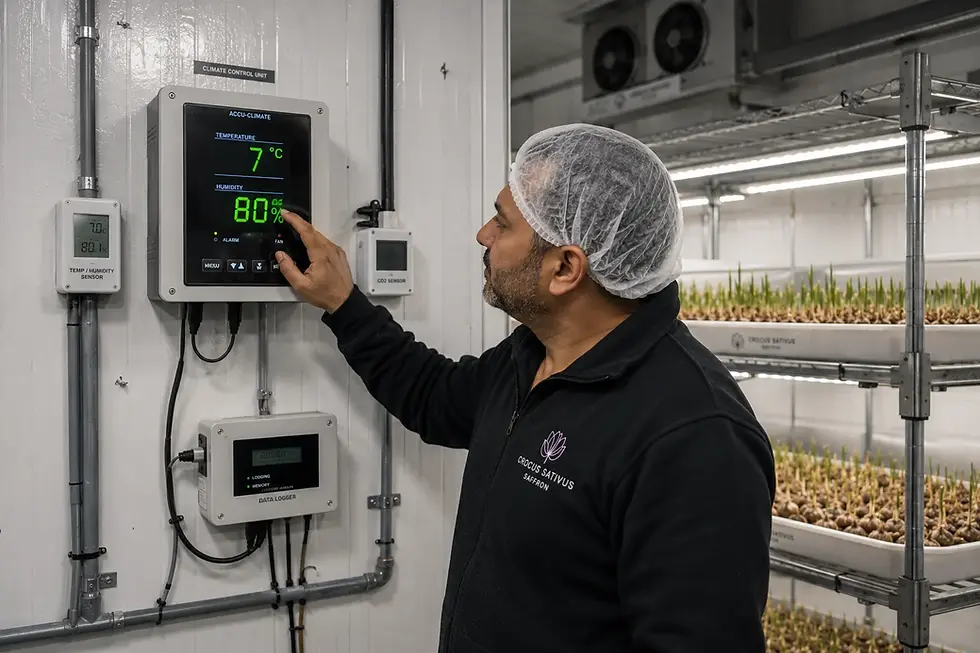
Saffron behaves like a temperature-programmed process. Each stage has a target band, and the transition between stages is what triggers biological response. This is the same discipline required in cold storage and pharmaceutical warehousing, where a chiller fault or a drifting setpoint quietly damages product.
Consider a typical scenario in a retrofitted cold room. A chiller that short-cycles or loses capacity may not trigger an obvious alarm, yet room temperature drifts by a few degrees over several days. In a saffron room, that drift can delay flowering, stagger the harvest window, and raise labor cost per kilogram. Without trend data, the cause is often found only after the batch is affected.
The infrastructure priorities for an indoor saffron facility are:
Properly sized chillers and air handling for stable temperature bands
Humidity control that does not fight the cooling system
Sensor coverage across racks, not only at the return air point
Data logging for batch traceability and buyer audits
Redundancy planning for chiller and power failures during critical stages
A chiller that drifts by a few degrees can delay flowering and stagger your harvest without triggering an alarm. Our engineers can review your chiller, HVAC, and monitoring setup and show where a batch could be at risk.
How Precite.ai Supports Saffron Farming with AI and Automation
Precite.ai focuses on AI-driven industrial automation, chillers, cold rooms, and HVAC intelligence, which are the systems an indoor saffron facility depends on. In practice, the approach covers four areas:
Stage-based setpoint automation: Temperature and humidity profiles are scheduled by growth stage, so transitions such as the cooling step-down are executed consistently instead of manually.
Predictive maintenance for chillers and HVAC: Compressor behavior, runtime patterns, and temperature trends are monitored so developing faults are flagged before they cause drift or downtime.
Energy optimization: Cooling is one of the largest operating costs in indoor cultivation. Load-aware control reduces unnecessary compressor cycling and helps lower energy cost per kilogram.
Remote monitoring and traceability: Continuous logs across rooms give plant managers alarms, audit records, and batch-level evidence of controlled conditions.
For decision-makers, the ROI case rests on avoided batch losses, lower energy consumption, and fewer emergency service calls. Actual savings depend on facility design, local power tariffs, and crop plan, and should be evaluated through a site assessment.
Frequently Asked Questions
How long does saffron take to grow from a corm?
Outdoors, corms planted in late summer typically flower in autumn, about six to ten weeks later. Indoors, flowering usually begins roughly four to eight weeks after corms are placed under flowering conditions. A full annual cycle is about 12 months.
How many times a year does saffron flower?
Saffron flowers once per year, and each corm produces flowers once per cycle. The harvest window lasts about two to three weeks, and individual flowers open for about a day.
How long does the saffron harvesting season last?
The saffron harvesting season is short, typically two to three weeks for a given bed or batch. Daily picking is required during that period, and stigmas must be dried promptly after separation.
Can saffron be grown indoors year-round?
Operators can stagger batches by managing corm storage and flowering conditions, but each corm still completes one dormancy-to-flowering cycle. Year-round production therefore depends on corm inventory, cold storage capacity, and precise climate control.
How many years does a saffron corm bed stay productive?
Outdoor beds are commonly renewed every three to five years as corms multiply and crowd. Indoor programs vary, depending on whether corms are treated as single-use or regrown for reuse.



Comments