


Farming of Kesar: Complete Guide to Cost, Climate, Cultivation & Profit
Farming of kesar, commonly known as saffron farming, is a specialized agricultural business with significant value potential. Kesar (Crocus sativus) is cultivated for its delicate red stigmas, which are used as a premium spice, food ingredient, coloring agent, and in various traditional applications.
In India, saffron cultivation has historically been concentrated in Jammu and Kashmir, where the natural climate is suitable for the crop. However, advances in controlled-environment agriculture have created interest in growing saffron in protected and indoor environments.
For anyone evaluating the farming of kesar as a business, understanding climate requirements, corm quality, cultivation methods, infrastructure, operating costs, yield, and market economics is essential.
This guide explains how kesar farming works, what conditions the crop requires, the major costs involved, potential profitability, and how AI-powered HVAC and automation can support commercial indoor saffron production.

What Is Farming of Kesar?
Farming of kesar refers to the cultivation of Crocus sativus, the plant commonly known as saffron crocus.
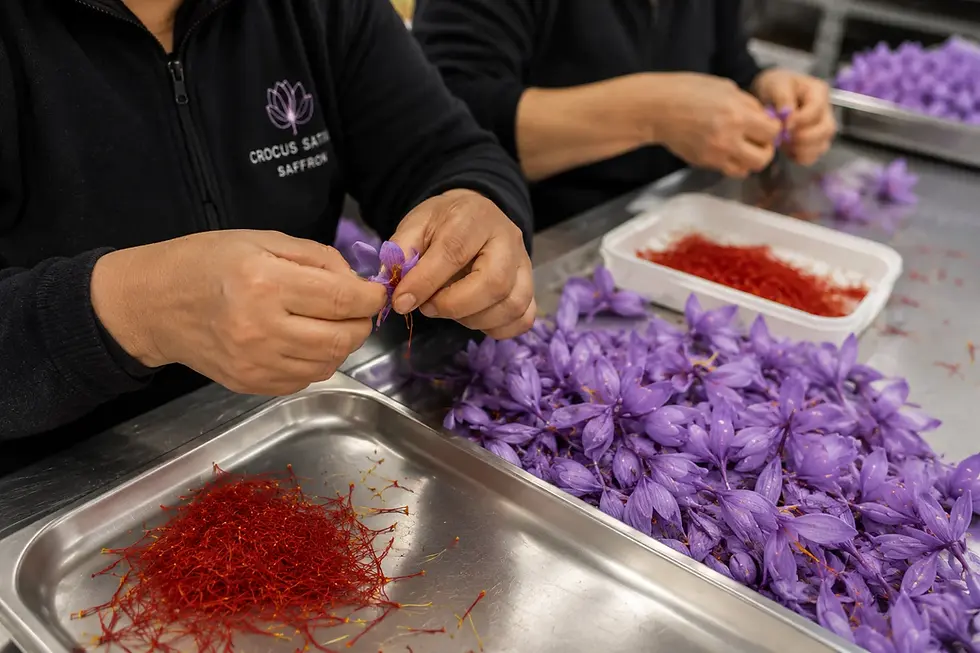
The commercially valuable part of the plant is the three red stigmas found inside each flower. These stigmas are carefully harvested and dried to produce saffron.
Unlike conventional field crops, saffron production requires careful management of its biological cycle. Corm quality, temperature, moisture, soil or growing medium, irrigation, disease management, flowering conditions, harvesting, and drying all influence the final product.
A successful kesar farming operation therefore requires more than simply planting corms. It requires a production system capable of maintaining suitable conditions throughout the crop cycle.
Farming of Kesar in India
India is particularly known for saffron production in Jammu and Kashmir, with Pampore being one of the most recognized saffron-growing areas.
Traditional farming benefits from the region's natural combination of elevation, seasonal temperature patterns, soil conditions, and rainfall.
However, traditional cultivation is exposed to environmental variability. Temperature, rainfall, humidity, and other weather conditions can affect agricultural performance.
This is one reason controlled-environment agriculture is attracting attention.
With an indoor saffron farming system, environmental parameters can be monitored and managed using HVAC equipment, cooling systems, sensors, ventilation, and automated controls.
However, indoor production should not be viewed as a shortcut. Its higher infrastructure and energy requirements mean that the business case must be carefully calculated.
Climate Required for Farming of Kesar
Climate is one of the most important considerations when planning saffron cultivation.
Saffron has different environmental requirements during different stages of its growth cycle. A commercial production system should therefore avoid using one fixed temperature and humidity setting for the entire crop.
Important environmental parameters include:
Temperature
Relative humidity
Air circulation
Moisture availability
Light conditions
Growing-medium moisture
Ventilation
Seasonal or crop-stage requirements
Why Temperature Matters
Temperature influences dormancy, vegetative development, flowering, and corm development.
In outdoor cultivation, these conditions are largely determined by the local climate. In an indoor facility, however, HVAC and cooling systems can be used to create controlled environmental conditions.
This provides greater operational control but also introduces energy costs.
Why Humidity Matters
Excessive humidity combined with poor air circulation can create an environment favorable to fungal and other disease problems.
For this reason, humidity should be monitored continuously in controlled environments rather than relying solely on occasional manual measurements.
Why Air Circulation Matters
Proper air movement helps maintain environmental uniformity within a growing room.
In a large indoor saffron facility, temperature and humidity may not be identical at every rack or growing zone. Sensor placement and airflow design are therefore important parts of the HVAC engineering process.
How to Start Farming of Kesar
A commercial saffron project should begin with agricultural planning rather than equipment purchasing.

1. Select Suitable Saffron Corms
Corm quality is one of the most important factors in saffron cultivation.
When sourcing planting material, growers should evaluate:
Corm size
Corm health
Disease-free condition
Source and traceability
Storage conditions
Variety or planting material characteristics
Using poor-quality corms can limit flowering performance even when environmental conditions are well controlled.
2. Select the Cultivation Method
There are several approaches to saffron production, including:
Traditional field cultivation
Protected cultivation
Controlled-environment cultivation
Indoor rack or tray-based systems
The appropriate method depends on climate, available space, investment capacity, electricity costs, labor availability, and target production volume.
3. Prepare the Growing Environment
For traditional farming, soil preparation and drainage are critical.
For indoor systems, the growing environment can include specially designed trays, racks, substrates, or other cultivation configurations.
The facility should allow operators to inspect plants, manage moisture, maintain airflow, clean the growing area, and harvest efficiently.
4. Manage Environmental Conditions
Temperature and humidity should be monitored throughout the production cycle.
An automated system can use sensors to continuously measure environmental conditions and activate cooling, ventilation, dehumidification, or other equipment when required.
5. Monitor Crop Development
Crop observations should be combined with environmental data.
Operators can record:
Crop stage
Flowering activity
Environmental conditions
Temperature deviations
Humidity deviations
Equipment runtime
Energy consumption
Disease or plant-health observations
This historical data becomes increasingly valuable when scaling production.
6. Harvest the Flowers
Saffron flowers are delicate and need careful handling.
The flowers are collected during flowering, after which the red stigmas are separated. Because the valuable portion of each flower is small, harvesting requires considerable manual attention.
Automation can improve the growing environment, but careful harvesting and post-harvest handling remain important human-operated activities.
7. Dry and Store the Saffron
Fresh saffron stigmas must be dried properly before storage.
Drying conditions can influence the final quality of saffron, including its color, aroma, flavor, and stability.
After drying, the product should be stored under suitable conditions that protect it from excessive moisture, light, heat, and contamination.
Farming of Kesar Cost in India
The cost of farming of kesar varies significantly depending on the production method.
A traditional field operation may require relatively limited infrastructure, whereas an indoor saffron farm can require substantial investment in climate-control equipment.
Major Cost Components
Cost Component | Traditional Farming | Indoor Saffron Farming |
Land preparation | Important | Less significant |
Saffron corms | Major expense | Major expense |
Growing infrastructure | Relatively low | Potentially high |
Racks and trays | Usually limited | Often required |
HVAC/cooling | Limited | Major consideration |
Humidity control | Basic/natural | Important |
Sensors | Optional | Recommended |
Automation | Limited | Valuable |
Electricity | Relatively low | Potentially significant |
Labor | Required | Required, especially for harvesting |
Drying and storage | Required | Required |
For indoor farming, investors should calculate total cost of ownership (TCO) instead of considering only the initial equipment price.
A useful commercial model includes:
Total Investment = Infrastructure + HVAC + Cooling + Electrical System + Racks + Sensors + Automation + Installation + Initial Planting Material
Operating expenditure should then include electricity, maintenance, labor, replacement parts, consumables, facility costs, and other recurring expenses.
Is Farming of Kesar Profitable?
The profitability of farming of kesar depends on production yield, product quality, market price, operating costs, and the efficiency of the production system.
A high saffron selling price alone does not guarantee profitability.
The basic business calculation is:
Gross Revenue = Saleable Saffron Yield × Realized Selling Price
Operating Profit = Gross Revenue − Operating Expenses
For an indoor operation, the calculation should also consider capital recovery and facility utilization.
Factors Affecting Kesar Farming Profit
Quality of saffron corms
Flowering performance
Final saffron yield
Product quality
Selling price
Electricity cost
HVAC efficiency
Facility utilization
Labor cost
Maintenance cost
Post-harvest losses
Sales channel
Businesses should build financial projections using conservative yield and price assumptions rather than relying on best-case scenarios.
Traditional vs Indoor Farming of Kesar
Parameter | Traditional Kesar Farming | Indoor Kesar Farming |
Weather dependence | High | Lower |
Climate control | Natural | Automated |
Initial investment | Generally lower | Generally higher |
Land requirement | Higher | Potentially lower footprint |
HVAC requirement | Limited | Significant |
Energy requirement | Lower | Higher |
Environmental monitoring | Manual/basic | Sensor-based |
Production consistency | Weather-dependent | Potentially more controlled |
Scalability | Land-dependent | Facility-dependent |
Automation potential | Moderate | High |
Indoor saffron cultivation becomes particularly interesting where land or natural climate is a limitation and the additional cost of environmental control can be justified by the business model.
Challenges in Farming of Kesar
Before investing in saffron cultivation, businesses should understand the main operational challenges.
1. Corm Quality
The quality of planting material directly influences the production potential of the farm.
2. Climate Management
Temperature and humidity must be managed according to crop stage. Poor environmental control can affect crop performance and increase disease risk.
3. Energy Consumption
For indoor saffron farming, cooling and environmental control may become major operating expenses.
This makes HVAC selection and control strategy extremely important.
4. Harvesting Labor
Although environmental control can be automated, saffron harvesting remains delicate and labor-intensive.
5. Market Access
Production is only one part of the business.
Growers should establish potential sales channels before scaling, including processors, wholesalers, retailers, exporters, specialty food businesses, and direct customers.
How AI and Automation Improve Indoor Farming of Kesar
An indoor saffron facility can be designed as a controlled industrial environment.
This creates opportunities to apply technologies already used in manufacturing, cold storage, HVAC systems, and process industries.
Real-Time Environmental Monitoring
Sensors can continuously collect information such as:
Temperature
Relative humidity
Equipment status
Energy consumption
Environmental deviations
Instead of manually checking conditions periodically, operators can see the condition of the facility continuously.
Automated HVAC Control
An automated control system can connect environmental sensors with HVAC and cooling equipment.
For example:
Temperature increases → sensor detects deviation → control system adjusts cooling → environmental condition moves toward the defined operating range.
This approach can reduce unnecessary manual intervention and improve consistency.
AI-Based Energy Optimization
Indoor farms can consume significant electricity for cooling and environmental management.
AI-based systems can analyze operating patterns to identify:
Unnecessary equipment runtime
Abnormal energy consumption
Inefficient cooling cycles
Temperature recovery problems
Opportunities for improved control
The objective should be to reduce energy consumption per unit of successful production, rather than simply minimizing HVAC runtime.
Predictive Maintenance
HVAC equipment is a critical production asset in an indoor farm.
If a cooling system fails, environmental conditions can change rapidly.
Predictive maintenance systems can analyze equipment behavior and identify unusual patterns before they develop into major failures.
Examples include:
Increasing compressor runtime
Unusual temperature recovery
Abnormal equipment cycling
Changes in cooling performance
Unexpected energy consumption
This can help maintenance teams move from reactive repairs toward planned intervention.
Remote Monitoring and Alerts
A connected system can alert operators when:
Temperature exceeds the defined operating range
Humidity changes unexpectedly
Cooling equipment stops
Energy consumption becomes abnormal
Sensors report inconsistent data
This is particularly valuable for facilities where operators cannot continuously remain inside the growing room.
How Precite.ai Can Help With Indoor Kesar Farming
Precite.ai brings an industrial automation approach to controlled-environment saffron production.
Instead of treating HVAC as a standalone piece of equipment, an intelligent system can connect sensors, cooling equipment, HVAC systems, automation controls, energy data, and operational intelligence.
A simplified architecture is:
Sensors → Data Collection → AI Analysis → Control Logic → HVAC/Cooling Equipment → Environmental Feedback
This creates a closed-loop system in which the environment is continuously measured and controlled.
For an indoor saffron facility, the major objectives are:
Maintain stable environmental conditions
Improve HVAC efficiency
Reduce unnecessary energy consumption
Detect equipment abnormalities
Minimize unplanned downtime
Provide real-time operational visibility
Generate useful historical data
The same principles can be applied beyond saffron farming.
Precite.ai's industrial automation capabilities can also support cold rooms, chillers, HVAC systems, food-processing facilities, manufacturing plants, and other temperature-sensitive operations.
For businesses planning an indoor saffron farm, the HVAC and automation layer should therefore be considered during facility design rather than added as an afterthought.
FAQs About Farming of Kesar
Is farming of kesar profitable in India?
Farming of kesar can be profitable when the crop achieves suitable yield and quality while production, labor, energy, and infrastructure costs remain under control. Profitability varies considerably by cultivation method and location.
What climate is required for farming of kesar?
Saffron requires suitable temperature and moisture conditions that vary throughout its production cycle. Traditional cultivation relies on the local seasonal climate, while indoor systems can use controlled environmental conditions.
How much investment is required for farming of kesar?
Investment depends on the cultivation method, land or facility requirements, quantity and quality of corms, irrigation, racks, HVAC, cooling, sensors, automation, labor, and other infrastructure.
Can kesar be grown indoors?
Yes. Controlled-environment saffron cultivation is possible, but commercial viability depends on maintaining appropriate crop conditions while keeping infrastructure and energy costs economically sustainable.
How can AI help in farming of kesar?
AI can analyze environmental and equipment data, support automated HVAC control, identify abnormal operating conditions, optimize energy use, and enable predictive maintenance for critical cooling equipment.



Comments