

Indoor Saffron Farming Business Model: Cost, Profit, ROI & 8-Year Financial Analysis (2026 Guide)
- 20 hours ago
- 5 min read
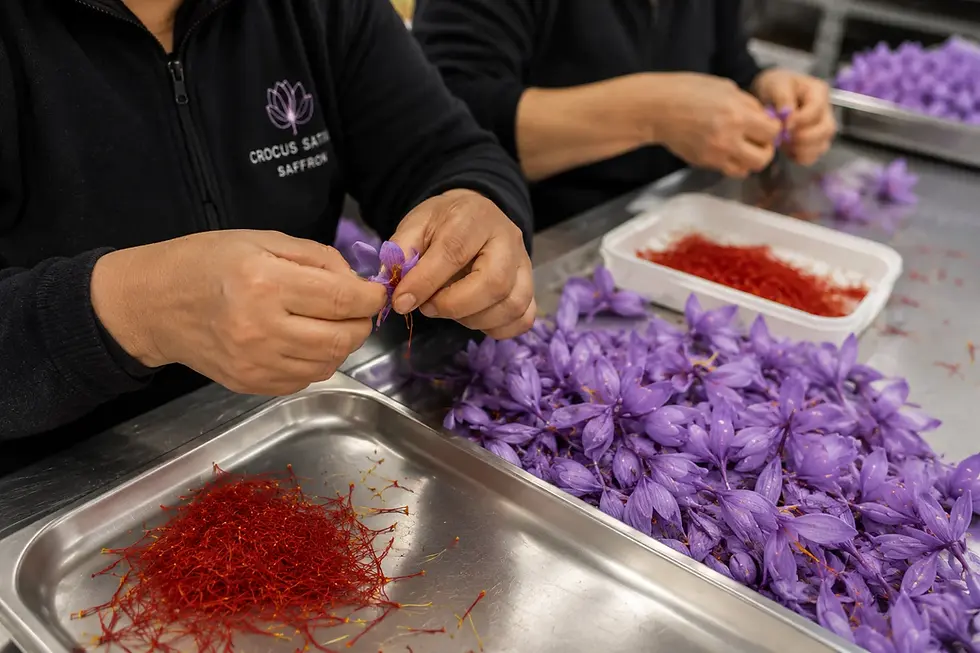
Indoor saffron farming is rapidly emerging as one of the most exciting opportunities in controlled-environment agriculture. Traditionally associated with the valleys of Kashmir, saffron cultivation is now being transformed through climate-controlled chambers, AI-powered monitoring systems, and precision farming technologies.
For entrepreneurs, investors, and progressive farmers, the biggest question remains:
Can indoor saffron farming actually be profitable?
The answer lies in understanding the complete business model, investment requirements, operating costs, bulb multiplication economics, and long-term profitability potential.
This guide breaks down the financial model of a 1,000-square-foot commercial indoor saffron farm and explores how technology-driven cultivation can create a scalable agricultural business.
What is Indoor Saffron Farming?
Indoor saffron farming is a controlled-environment cultivation method where saffron bulbs are grown inside specially designed chambers that regulate:
Temperature
Humidity
CO₂ levels
Lighting spectrum
Air circulation
Irrigation conditions
Unlike traditional field cultivation, indoor farming eliminates dependence on seasonal weather and enables year-round production cycles with predictable results.
Advanced systems integrate AIoT controllers, environmental sensors, refrigeration systems, humidifiers, dehumidifiers, and specialized grow lights to maintain ideal growing conditions throughout the crop cycle.
Why Indoor Saffron Farming is Gaining Attention
Saffron is one of the world's most expensive agricultural products.
Premium-grade saffron can sell for anywhere between ₹4 lakh and ₹12 lakh per kilogram depending on quality, laboratory grading, and market demand.
Several factors are driving interest in indoor cultivation:
Increasing global saffron demand
Limited traditional production regions
Climate change affecting conventional farming
Better quality control indoors
Higher production predictability
Long-term bulb multiplication opportunities
Unlike many crops that generate revenue only from harvest, saffron farming creates additional value through bulb multiplication and byproduct utilization.
Project Overview: 1,000 Sq Ft Commercial Indoor Saffron Farm
A standard commercial setup includes:
Parameter | Value |
Farm Area | 1,000 Sq Ft |
Mother Bulbs | 1,000 Kg |
Bulb Cost | ₹2,500/kg |
Total Bulb Investment | ₹25 Lakh |
Infrastructure Investment | ₹30 Lakh |
Total Project Cost | ₹55 Lakh |
Production Cycles | 2 Per Year |
Year 1 Production | 3 Kg Saffron |
Project Horizon | 8 Years |
This scale is large enough to achieve commercial viability while remaining manageable for first-time operators.
Indoor Saffron Farming Cost in India
One of the most common questions asked by investors is:
How much does it cost to start indoor saffron farming?
The estimated project cost for a professional commercial setup is approximately ₹55 lakh.
Capital Expenditure (CapEx)
1. Mother Bulbs – ₹25 Lakh
Mother bulbs form the biological foundation of the project.
The model assumes:
1,000 kg bulb inventory
Average procurement price ₹2,500/kg
Mixed commercial-grade bulb sourcing
2. Indoor Farming Infrastructure – ₹30 Lakh
The infrastructure includes:
Insulated cultivation chamber
Refrigeration system
Humidification system
Dehumidification system
CO₂ management
AI-powered control system
Sensor network
Vertical rack systems
Specialized grow lights
Cold storage facility
Installation and training
Together, these systems create the environmental precision necessary for commercial saffron production.
Annual Operating Cost (OpEx)
Operating expenses determine long-term profitability.
The annual operating cost for a 1,000 sq ft indoor saffron farm is approximately:
₹13.2 Lakh Per Year
Major Cost Components
Expense Category | Annual Cost |
Manpower | ₹6,00,000 |
Electricity | ₹1,20,000 |
Consumables | ₹96,000 |
Marketing | ₹96,000 |
AMC & Maintenance | ₹90,000 |
Testing & Compliance | ₹1,08,000 |
Miscellaneous | Remaining Balance |
Interestingly, labor accounts for nearly 45% of total operating expenses, making manpower management critical for profitability.
The Hidden Advantage: Energy Efficiency
Energy costs often determine whether a controlled-environment agriculture project succeeds or fails.
Modern AI-powered chambers reduce electricity consumption through:
Variable-speed compressor systems
Smart humidity scheduling
Adaptive cooling controls
Optimized airflow management
Energy-efficient lighting systems
These technologies can significantly reduce operating expenses over the life of the project.
The Real Profit Driver: Bulb Multiplication
Most people view saffron as a spice business.
Experienced operators understand it is actually a biological asset business.
Every saffron bulb produces daughter bulbs underground during its reproductive cycle.
Over time, these daughter bulbs mature into productive mother bulbs, creating a compounding effect.
How Bulb Compounding Works
A mature bulb can generate multiple daughter bulbs over its productive life.
This creates exponential growth in productive bulb mass.
Estimated Productive Bulb Growth
Year | Productive Bulbs |
Year 1 | 1,000 Kg |
Year 2 | 1,000 Kg |
Year 3 | 1,500 Kg |
Year 4 | 2,250 Kg |
Year 5 | 3,375 Kg |
Year 6 | 5,062 Kg |
Year 7 | 7,593 Kg |
Year 8 | 11,390 Kg |
This compounding mechanism is the foundation of long-term profitability.
Saffron Production Growth Over 8 Years
As bulb inventory increases, saffron output increases as well.
Estimated Saffron Yield
Year | Production |
Year 1 | 3 Kg |
Year 2 | 3 Kg |
Year 3 | 4.5 Kg |
Year 4 | 6.75 Kg |
Year 5 | 10.12 Kg |
Year 6 | 15.19 Kg |
Year 7 | 22.78 Kg |
Year 8 | 34.17 Kg |
This means the same cultivation chamber can potentially produce more than eleven times its initial output through bulb multiplication.
Revenue Streams in Indoor Saffron Farming
Many business plans focus solely on saffron sales.
However, successful indoor saffron farms generate revenue from multiple sources.
1. Saffron Stigmas
This is the primary revenue stream.
Typical selling price:
Standard Quality: ₹4–6 Lakh/Kg
Premium Quality: Up to ₹12 Lakh/Kg
Base-case calculations generally use ₹5 Lakh/Kg.
2. Daughter Bulb Sales
Daughter bulbs can be:
Reinvested for expansion
Sold to new saffron growers
Exported to international buyers
Typical market price ranges between:
₹3,000–₹3,500 per kilogram
3. Saffron Byproducts
Several valuable byproducts are generated from the flower:
Saffron Petals
Used in:
Herbal teas
Cosmetics
Natural extracts
Skincare products
Saffron Styles
Used in:
Culinary applications
Ayurvedic formulations
These byproducts add additional income without increasing cultivation costs.
Two Business Models for Indoor Saffron Farming
Scenario A: Reinvest Daughter Bulbs
Under this model:
All daughter bulbs remain in the operation.
Productive inventory compounds annually.
Saffron production increases exponentially.
Benefits:
✔ Higher long-term profits
✔ Larger biological asset base
✔ Greater future production capacity
This strategy is suitable for entrepreneurs seeking long-term wealth creation.
Scenario B: Sell Daughter Bulbs
Under this model:
Productive bulb inventory remains relatively stable.
Surplus bulbs are sold annually.
Cash flow becomes more predictable.
Benefits:
✔ Faster cash generation
✔ Earlier break-even
✔ Lower operational expansion requirements
This approach appeals to investors prioritizing liquidity and shorter-term returns.
Break-Even Analysis
A professionally engineered indoor saffron farming project typically reaches break-even within:
4–5 Years
The exact timeline depends on:
Selling price achieved
Production performance
Financing structure
Bulb management strategy
Projects focused on bulb sales generally break even sooner, while reinvestment strategies generate greater long-term returns.
Is Indoor Saffron Farming Profitable?
The answer depends on execution quality.
Success factors include:
High-quality bulb sourcing
Precise environmental control
Skilled operations management
Efficient energy usage
Proper market positioning
Strong quality assurance
When these factors align, indoor saffron farming becomes more than a crop business—it becomes a biological asset that compounds in value over time.
Final Thoughts
Indoor saffron farming represents a unique intersection of agriculture, biotechnology, climate control, and artificial intelligence.
Unlike conventional farming, where productivity is heavily dependent on weather, indoor cultivation allows growers to create a predictable and scalable production environment.
The most important takeaway is that saffron farming is not simply about harvesting red stigmas. The real business model combines:
Premium saffron production
Daughter bulb multiplication
Byproduct monetization
Technology-driven efficiency
Long-term biological asset growth
For entrepreneurs looking to enter high-value agriculture, indoor saffron farming offers one of the most compelling opportunities in the controlled-environment farming sector.



Comments